
Iosco County Criminal History Checks
Start with the layer most likely to answer the question. MiCOURT shows public cases filed in Iosco County. A misdemeanor or the first stages of a felony belong in the 81st District Court search. A felony that was bound over belongs in the 23rd Circuit Court search. ICHAT, the Michigan State Police name-check portal, has broader statewide reach but narrower content. It covers qualifying reported Michigan felony arrests and serious misdemeanors tied to fingerprints. It does not show warrants, federal matters, juvenile files, suppressed records, or every local event.
Good identifiers prevent false matches. Use the full legal name, prior spellings, and date of birth when the official form permits. A common name should never be matched on spelling alone. When a result matters, compare its court, case number, charge, date, and disposition with the clerk’s record.
- Search both Iosco court divisions in MiCOURT Case Search, starting with the court that fits the case stage.
- Use ICHAT for the public statewide repository layer and enter the required identity fields accurately.
- Call the Sheriff’s Control Center for current local custody or warrant routing because no official public Iosco roster or warrant list was found.
- Ask the arresting agency for its incident report and the correct clerk for filed documents or certified dispositions.
- Use the Michigan State Police correction process if repository data remains wrong after the court record is confirmed.
Three Iosco Criminal Record Offices
Iosco County has a compact but divided records corridor. The Courthouse Annex at 420 W. Lake Street holds the 81st District Court and the local MDOC parole and probation office. The County Building at 422 W. Lake Street holds the County Clerk, 23rd Circuit Court, and Prosecuting Attorney. The Sheriff and 63-bed County Jail are at 428 W. Lake Street. Those nearby doors hold different parts of one event.
A new felony may appear first at District Court, while its later information, plea, and sentence sit in Circuit Court. The booking file remains with the sheriff. Prosecutor records belong to the charging office and are not a substitute for the police report or the official court file. The Iosco County government directory shows the county office structure.
The county directory helps identify the right custodian before a caller or visitor starts at the wrong counter.
81st District Court
420 W. Lake St., Tawas City, MI 48763
989-362-2573
Misdemeanors and early felony proceedings
County Clerk and Circuit Court
422 W. Lake St., Tawas City, MI 48763
989-362-3497
Bound-over felony files and certification
Sheriff and County Jail
428 W. Lake St., Tawas City, MI 48763
989-362-6164
Custody, booking, warrants, and fingerprints
Official Background Checks in Michigan
The Michigan State Police Criminal Justice Information Center maintains the central criminal-history repository. Any member of the public may use ICHAT for a name-based search. The portal requires first and last name, sex, race, and date of birth, with a middle name available to narrow a match. Each search costs $10. A result is not fingerprint-confirmed, so verify a possible match with the court of conviction.
For review of one’s own fingerprint-linked Michigan record, MSP directs the person through its fingerprint and RI-008 process. The purpose and requesting-agency code decide which route applies. Iosco Sheriff offers local Live Scan and ink-card service. The FBI Identity History Summary is also subject-only and covers fingerprints reported to the FBI, not simply an Iosco court name search.
The Michigan State Police criminal-history overview explains what the public repository includes and omits.
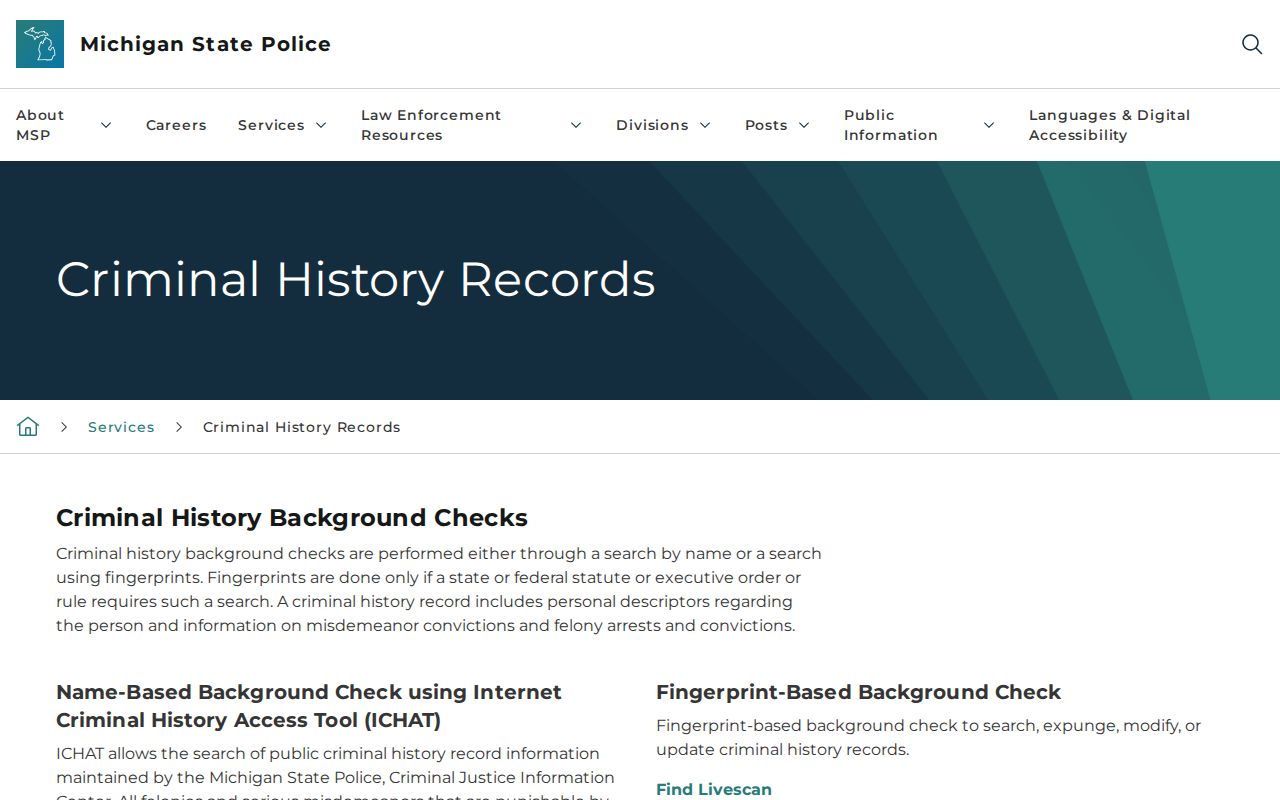
This state explanation is the key check on assumptions about a name-search result.
| Channel | Coverage | Published Cost |
|---|---|---|
| MiCOURT | Selected public Iosco court dockets | Free online |
| ICHAT | Qualifying public Michigan repository entries | $10 per search |
| Local Live Scan | Purpose-based fingerprint submission | $61.25 |
| Fingerprinting service | Local printing service at the sheriff | $15 |
| Ink-rolled print | Fingerprint card prepared locally | $10 |
| FBI direct summary | One’s own FBI identity history | $18, plus printing if applicable |
Iosco ICHAT Record Search Limits
An ICHAT no-hit is not proof that no Iosco County record exists. The event may be too new, outside the public product’s offense range, not fingerprinted, suppressed, juvenile, or missing a matched disposition. Warrants are excluded. Federal and out-of-state records are excluded as well. A local incident that never became a qualifying reported arrest can still exist at the police agency.
The portal works best as one layer. Search fields include last name, first name, optional middle name, sex, race, date of birth, and a terms acknowledgment. If ICHAT and MiCOURT disagree, obtain the court disposition first. MSP instructs the subject to use its challenge or update path with supporting court records rather than assume a clerk’s correction automatically changed CJIC.
| ICHAT Field | Use | Status |
|---|---|---|
| Last and first name | Enter the legal or known name with accurate spelling | Required |
| Middle name | Helps separate people with similar names | Optional |
| Sex and race | Identity matching fields used by the portal | Required |
| Date of birth | Enter the exact date in the requested format | Required |
| Terms acknowledgment | Confirms the portal conditions before checkout | Required |
The Criminal Justice Information Center maintains the repository and publishes contact routes for criminal-history help.
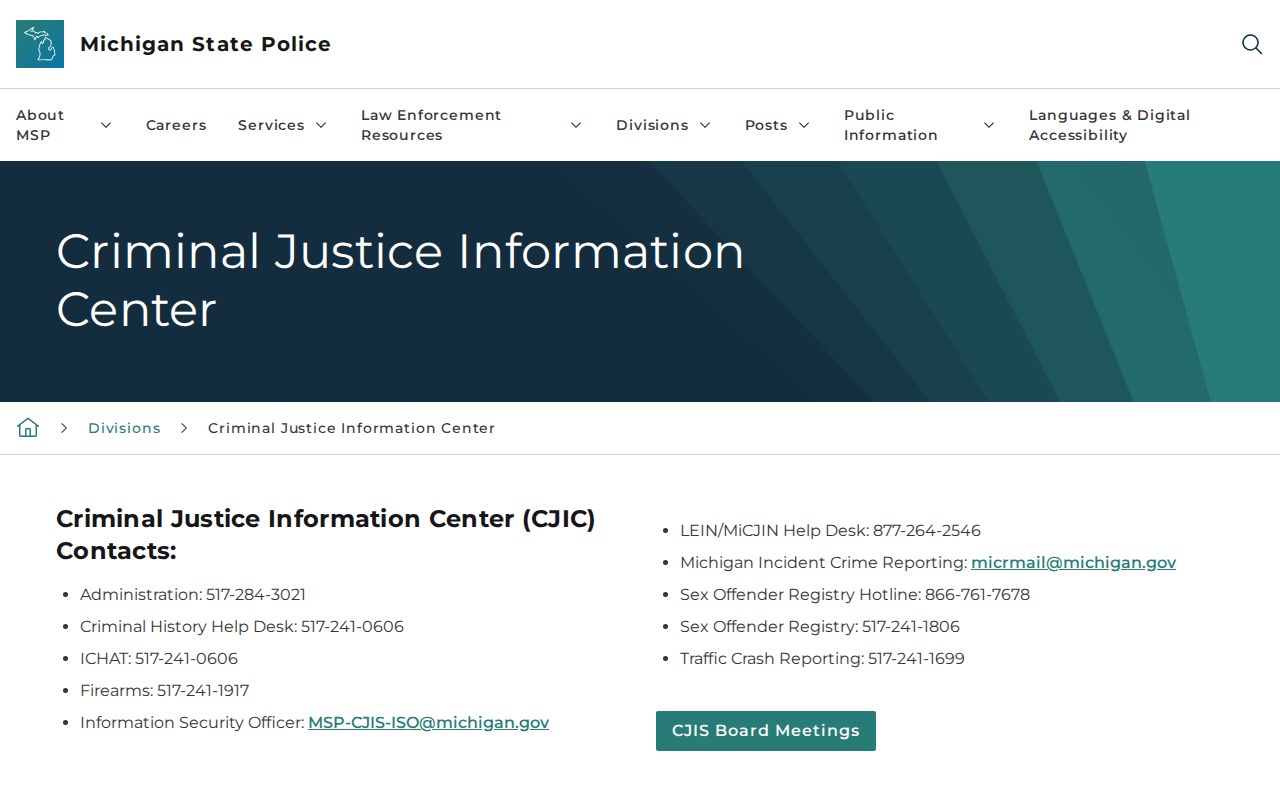
CJIC is the state endpoint for repository questions, while an Iosco clerk controls the county court file.
Kinds of Criminal Records
Criminal records are created at separate stages. The arresting agency writes an incident or arrest report. Iosco Jail creates a custody-centered booking record. The prosecutor chooses which allegations to charge. Court clerks then record hearings, pleas, outcomes, sentences, and financial orders. CJIC links qualifying fingerprinted arrest cycles to reported dispositions, and MDOC creates prison or felony-supervision records.
Knowing the source prevents overreading any one result. An arrest allegation can change before charging. A jail entry does not prove guilt. A docket is case-centered rather than a full police narrative, and an ICHAT entry is not a live custody check.
- Incident and arrest report: the creating police agency holds its narrative and evidence-related fields.
- Booking record: the sheriff records intake, agency, booked charges, bond, and custody status.
- Court case file: the proper clerk holds docket events, filed charges, disposition, and sentence.
- Repository entry: CJIC links qualifying reported Michigan arrest and outcome data.
- Corrections record: MDOC records qualifying prison, parole, and felony probation information.
No Iosco Jail Record Roster
No official public Iosco County jail roster, daily booking log, arrest blotter, or active-warrant search was located. The official fallback begins with the Sheriff’s Control Center at 989-362-6164. Staff may route a current custody question, but administrative copies may require a focused written FOIA request. Include the full name, approximate date and place, incident number if known, the record sought, and the preferred format.
Use MiCOURT for bond and hearing entries because the court sets judicial bond. Use OTIS only for a person sentenced to MDOC custody or qualifying felony supervision. OTIS expressly omits county-jail-only cases. The absence of an online roster should not be filled with a commercial jail or mugshot source. For a present warrant concern, contact the issuing court or sheriff and confirm whether any recall has actually been entered.
Iosco County Criminal Records: What They Contain
A record’s fields reflect its purpose. Court data may show the case number, tracking control number, filing and offense dates, charge description, statute, status, hearing dates, plea, disposition, sentence, bond, and financial obligations. A booking file emphasizes intake and custody. Repository data focuses on identity and fingerprint-linked arrest cycles. Protected identifiers, victim and minor data, medical material, confidential addresses, and nonpublic cases may be withheld or redacted.
| Name and Identifiers | Names, aliases, permitted demographic fields, and tracking identifiers used to distinguish records. |
|---|---|
| Arrest and Booking | Arresting agency, date, booked allegations, intake, holds, bond, and custody or release status. |
| Charges and Statutes | Complaint or information counts, offense descriptions, citations, and felony or misdemeanor designation. |
| Disposition | Outcome at the charge or case level, such as dismissal, plea, conviction, or acquittal. |
| Sentence | Custody, probation, fines, costs, restitution, and other terms recorded by the court. |
| Supervision Status | Qualifying MDOC prison, parole, or felony-probation status, subject to OTIS limits. |
Iosco Corrections Records in OTIS
MDOC’s Offender Tracking Information System can locate qualifying state prisoners, parolees, and felony probationers. Search by MDOC number when known. A name search can also use sex, race, age, status, and marks or tattoos as filters. A profile may show the MDOC number, aliases, physical descriptors, sentence offenses, sentencing county, supervision status, and a linked facility or field office.
OTIS keeps qualifying public data for three years after discharge from supervision. It is not a complete criminal-history check and does not cover a person held only in Iosco County Jail. The local MDOC Parole/Probation office is at 420 W. Lake Street, in the courthouse annex, and its phone is 989-362-2966. District Court misdemeanor probation remains a separate court operation.
The official MDOC OTIS information page states the locator’s scope and exclusions.
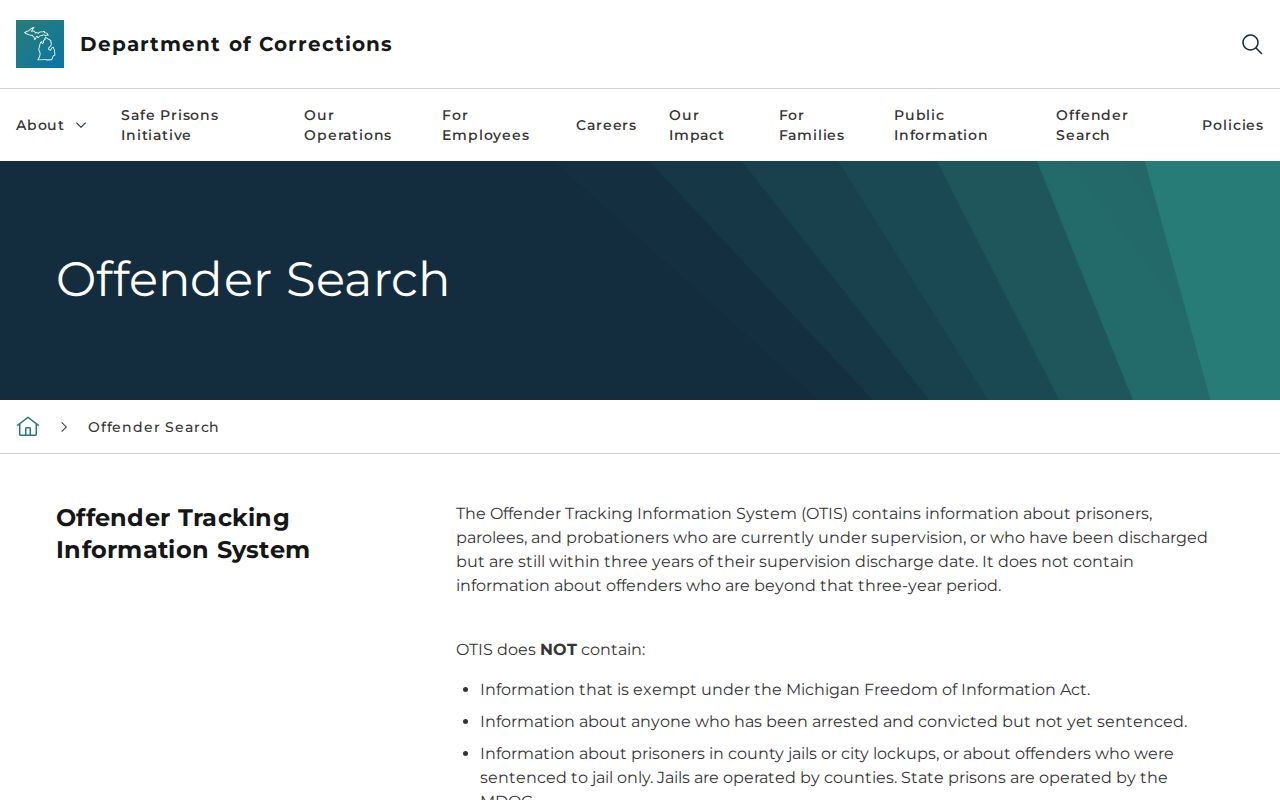
The OTIS source makes clear why a county jail search and a state corrections search answer different questions.
The MDOC Region 3 office directory lists the local supervision office.
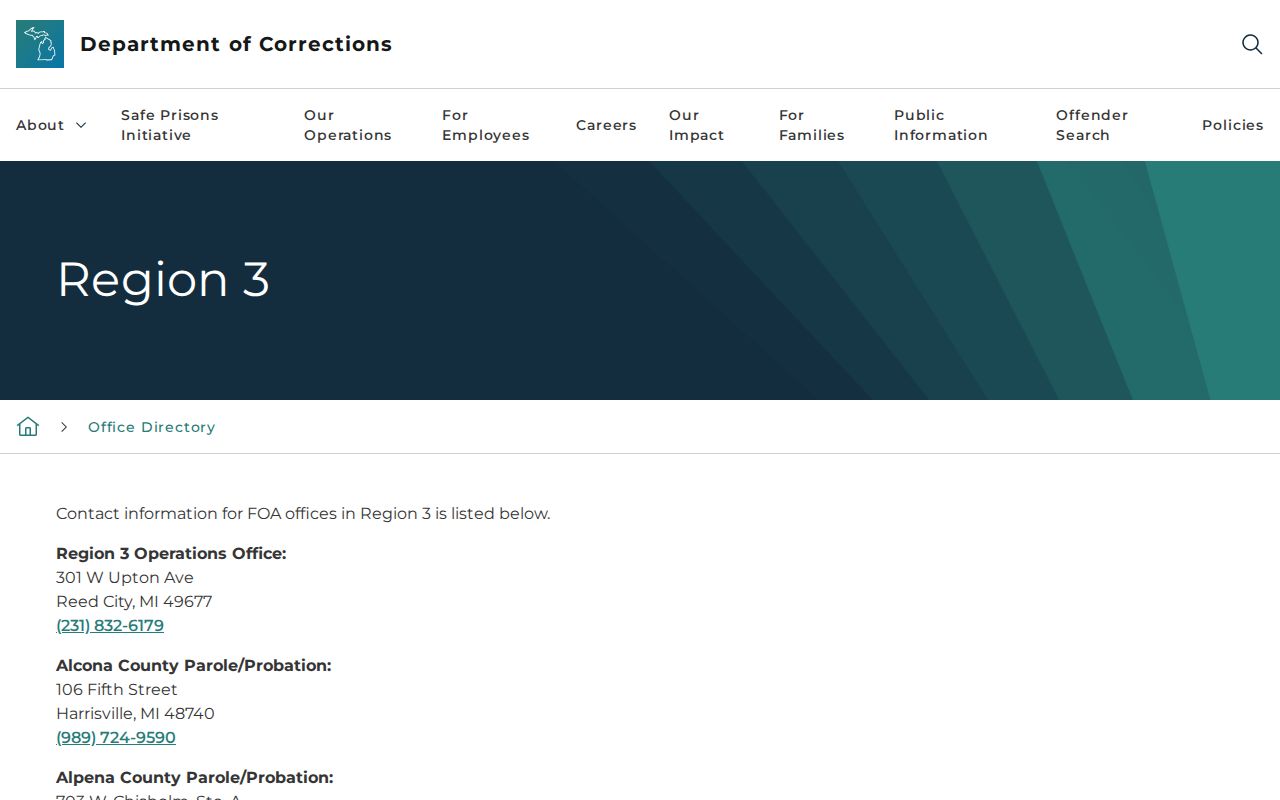
That office listing connects a public OTIS status to the official Iosco field-operation contact.
Michigan Public Access Laws
Michigan FOIA governs access to records held by county and local executive agencies. A request goes to the office that created or keeps the record, and it should describe an existing record rather than ask an office to write a new report. The agency generally responds within five business days or issues one written extension of no more than ten business days. That is a response deadline, not always the production date.
Court records follow Michigan Court Rule 8.119 and clerk procedures, not ordinary FOIA. Criminal-history dissemination has its own statute. Redactions or denials may protect active investigations, LEIN information, victims, minors, medical data, and security-sensitive content.
Key Michigan authorities:
MCL 15.231 states Michigan’s policy of public access under FOIA.
MCL 15.233 sets written-request, inspection, and copying rights.
MCL 15.243 lists privacy and law-enforcement exemptions.
MCL 28.243 governs criminal-history collection, use, and dissemination.
MCL 780.621 sets the framework for applications to set aside eligible convictions.
Historic Iosco Criminal Court Records
Older Iosco County criminal files may sit outside modern search systems. The Archives of Michigan county guide identifies Circuit Court case files from 1860 through 1938, criminal dockets from 1934 through 1956, and prosecuting-attorney dockets from 1911 through 1946. Those holdings can support genealogy and local-history work when MiCOURT has no electronic result.
Begin with the Iosco County Clerk when the age or storage location is uncertain. Give a name, approximate year, court, and any case number found in an index. The clerk can say whether the material remains local or has transferred. MiCOURT’s lack of an old entry does not show that no paper, microfilm, docket, or archive record exists.
Restricted, Sealed & Expunged Records
Juvenile files, nonpublic identifiers, victim and minor details, LEIN-only data, sealed warrants, and set-aside records are common access limits. Redaction is not the same as sealing. A redacted file remains public with protected fields removed, while a set-aside conviction is generally withheld from ordinary public access. Authorized government uses may still exist.
Michigan calls its court process “setting aside” a conviction, though “expungement” is common speech. Eligibility depends on the exact offense, record mix, and waiting period. Current law generally permits applications for up to three felonies with no numerical limit on misdemeanors, subject to offense and combination restrictions. Common waiting periods are seven years for more than one felony, five years for one felony, and three years for misdemeanors, measured from the latest controlling event.
Automatic Clean Slate relief applies only to eligible records after statutory periods. It differs from an application filed in the convicting Iosco court. After either route, retain the order and recheck both the court and ICHAT. The MSP conviction set-aside information supplies the current state route.
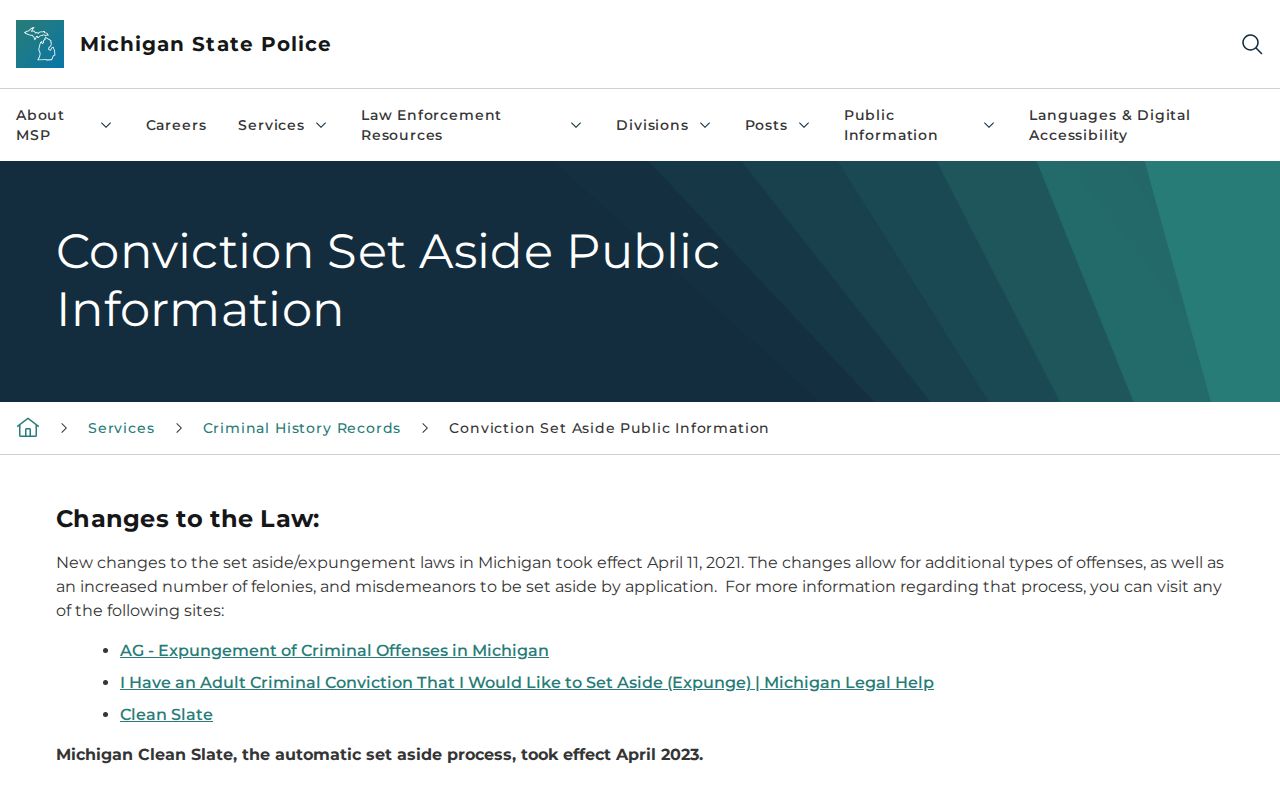
The official set-aside material helps distinguish automatic processing from an application in 81st District or 23rd Circuit Court.
Iosco Criminal Court Record Terms
Short docket labels can hide major differences. Read each term at the charge level and follow later events before drawing a conclusion. An arrest allegation, prosecutor-authorized charge, and final conviction may not be the same offense.
- Arraignment
- The first formal court appearance where charges and rights are addressed.
- Disposition
- The recorded outcome of a charge or case.
- Bindover
- Transfer of a felony from District Court to Circuit Court after waiver or a probable-cause finding.
- Dismissal
- Termination of a charge without conviction; it does not erase the arrest by itself.
- Probation
- A court sentence involving supervision in the community.
- Parole
- Conditional community release from an MDOC prison sentence.
A case may contain several dispositions, one for each count. The latest event and certified judgment provide more context than a single status label.
Iosco Booking to State Record
The arresting agency starts the trail. Iosco Sheriff, East Tawas Police, Tawas City Police, Oscoda Township Police, MSP, or another authorized agency writes the incident record. For a reportable offense, fingerprints and arrest data move to CJIC under a tracking control number. The prosecutor then may authorize, change, or decline charges.
The 81st District Court records the first judicial steps. A felony that survives preliminary examination moves to 23rd Circuit Court. The disposition should return to CJIC and attach to the arrest cycle. MDOC adds custody or supervision data after a qualifying felony sentence. Delays, unmatched identifiers, and missing disposition reports explain why the jail, court, ICHAT, and OTIS may show different stages at the same time.
City-by-City Criminal Records in Iosco County
East Tawas and Tawas City operate police departments, but neither city has a municipal court or long-term jail. Their police reports remain with the creating city agency, while bookings and cases route into the Iosco County system. Whittemore has no standalone police records portal found in official sources, so its practical path begins by identifying whether the sheriff, MSP, or another agency handled the event. Oscoda is a larger named community, but it is a census-designated place rather than an incorporated city.
Each city route below follows the incorporated-city ranking in the county research and keeps the city police layer separate from county court and custody records.
East Tawas Record Check
East Tawas Police offers a written FOIA form; court cases route to Iosco’s state trial courts.
Tawas City Record Check
Tawas City Police maintains city reports; the county-seat court and jail corridor holds later stages.
Whittemore Record Check
County and state agencies supply the report, custody, court, and repository channels.
Iosco Criminal Records Request Routing
A focused request begins with the creating agency. Ask East Tawas Police for an East Tawas officer’s report, Tawas City Police for its own report, MSP for an MSP file, and Iosco Sheriff for a sheriff or jail record. The prosecutor’s published FOIA form reaches prosecutor-held material only. It does not transfer a police narrative or certified judgment into that office’s custody.
Describe the date and time range, place, incident or case number, record type, and desired electronic or paper format. No current fixed sheriff report fee or county court certification fee was located in official sources, so confirm charges before ordering. The sheriff is open around the clock for control-center work, but callers should verify when an administrative records employee can process a copy request.